Hubei Hannas Tech Co.,Ltd-Professional Piezoceramic Elements Supplier
Hot Keywords:
- All
- Product Name
- Product Keyword
- Product Model
- Product Summary
- Product Description
- Multi Field Search

Views: 0 Author: Site Editor Publish Time: 2026-07-19 Origin: Site


Reliable subsea networks power today's deep-water exploration and advanced defense systems. These complex networks rely heavily on unmanned underwater vehicles (UUVs), autonomous underwater vehicles (AUVs), and robust subsea telemetry. They require highly specialized transducers to successfully bridge the gap between high power output and broad frequency bandwidth.
Specifying piezo ceramics for underwater communication involves much more than simply picking a material with the highest coupling coefficient. You must carefully balance extreme hydrostatic pressure tolerance, acoustic impedance matching, and delicate signal-to-noise ratios. A slight engineering miscalculation can trigger catastrophic communication blackouts in harsh oceanic environments.
We designed this guide to give design engineers and procurement teams a strict, evidence-based evaluation framework. You will learn how to confidently evaluate and shortlist piezoelectric materials for subsea acoustic modems. Read on to master the essential metrics that dictate long-term deployment success.
Material tradeoffs are unavoidable: High-power transmission requires "hard" PZT (e.g., PZT-4/PZT-8), while broadband data reception favors "soft" PZT or piezocomposites.
Geometry dictates directionality: Piezo Tubes offer omnidirectional radial transmission ideal for communication networks, whereas discs/plates are better suited for directional, long-range point-to-point pings.
Pressure limits component lifespan: Depolarization and mechanical stress under high hydrostatic pressure are the primary failure points in subsea deployments.
Supplier testing is critical: Final vendor selection must hinge on their ability to provide tight tolerance matching and verifiable pressure-vessel acoustic testing.
Deep-water environments actively destroy standard electronic components. Rapid material degradation happens when ceramics face immense hydrostatic pressures. Engineers also fight severe acoustic impedance mismatches between dense ceramic elements and the surrounding seawater. These mismatches actively reflect acoustic energy back into the device housing. This physical phenomenon causes massive communication failures. Retrieving failed hardware from the ocean floor is both incredibly difficult and resource-intensive. You need a much stricter approach to subsea network design.
To evaluate potential solutions, we must first define what actual operational success looks like. The success criteria for modern subsea acoustic networks depend on three vital performance pillars:
Maintain consistent electro-acoustic efficiency across drastically varying depths and pressure levels.
Achieve a sufficiently broad bandwidth to support high data rates for Frequency Shift Keying (FSK) and Phase Shift Keying (PSK) modulation schemes without excessive physical ringing.
Ensure predictable operational longevity and strict resistance to depolarization over a multi-year lifespan.
We must strongly acknowledge the impedance mismatch hurdle. Water is far less dense than solid piezoelectric ceramics. Acoustic energy naturally bounces off boundaries where material densities clash. This stark difference in acoustic impedance necessitates highly precise matching layers on your transducers. Without these specialized layers, energy simply reflects internally instead of propagating through the ocean, rendering the modem useless.
Choosing the correct ceramic formulation ultimately dictates device capability. Every Underwater Acoustic Transducer needs a specific grade of piezoelectric material based on its primary function in the array. You cannot force a single material grade to excel at everything.
Engineers evaluate hard PZT for its exceptionally high mechanical quality factor (Qm) and very low dielectric loss. These formulations excel in high-power acoustic projectors. You can sustain strong, continuous transmissions without dangerously overheating the array. However, a major engineering tradeoff exists here. Their inherent narrow bandwidth severely limits complex data transmission rates. Hard PZT struggles to support rapid phase shifts in modern data modems.
These specialized grades provide very high piezoelectric charge coefficients (d33). They also boast remarkably high permittivity. You will find them best suited for highly sensitive hydrophones. They act as excellent receivers to detect weak, long-range signals propagating through noisy oceans. The primary tradeoff? They remain highly susceptible to rapid depolarization when subjected to high mechanical stress or extreme ocean depths.
These advanced structures merge active ceramic pillars within a passive polymer matrix. They feature a significantly lower acoustic impedance that closely matches liquid water. They offer a much wider bandwidth due to their intentionally lowered Qm. They are ideal for high-data-rate applications. You can often handle both digital transmission and sensitive reception seamlessly in a single physical package.
The chart below outlines how these materials compare across critical engineering metrics.
Material Grade | Primary Strength | Ideal Application | Major Tradeoff |
|---|---|---|---|
Hard PZT (PZT-4/8) | High Qm, low heat generation | High-power acoustic projectors | Narrow bandwidth limits data rates |
Soft PZT (PZT-5A/5H) | High sensitivity (d33) | Passive listening hydrophones | Vulnerable to depth-induced depolarization |
1-3 Piezocomposites | Wide bandwidth, matched impedance | High-speed acoustic modems | Complex manufacturing requirements |
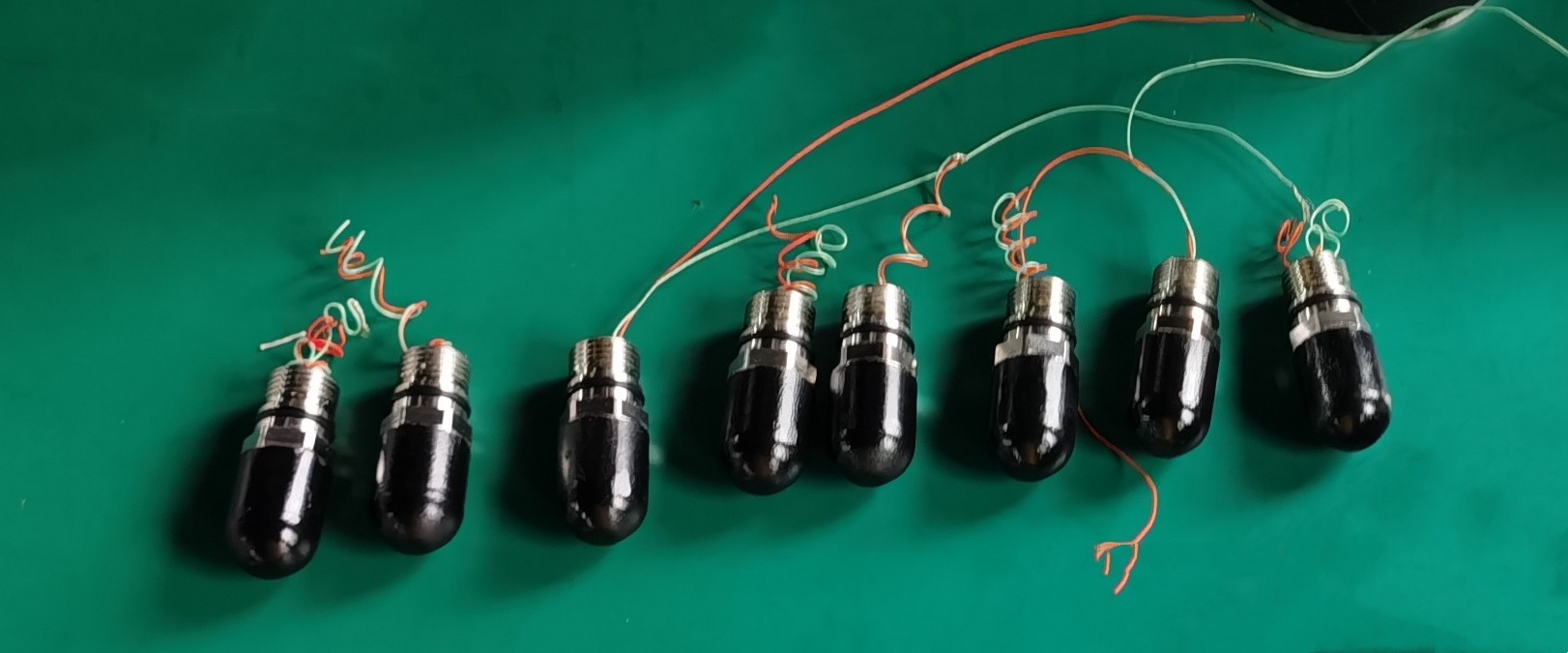
Physical shape heavily controls acoustic radiation patterns. Cylindrical transducers, commonly known as Piezo Tubes, provide true 360-degree radial acoustic radiation. Discs and plates push sound in a straight, highly focused line. Directional beaming works perfectly for targeted sonar but fails miserably for dynamic communication networks. Omnidirectionality forms the absolute baseline requirement for untethered underwater communication. UUV-to-surface links and node-to-node telemetry rely entirely on sound propagating equally in all horizontal directions.
The physical dimensions of the cylinder dictate its acoustic properties. Wall thickness and outer diameter directly set both the radial and wall-thickness resonance frequencies. A key design consideration involves balancing physical size constraints. Your pressure housing has strict dimensional limits. Yet, long-range acoustic propagation demands low-frequency operation. Achieving these lower frequencies usually requires much larger ceramic geometries, forcing a difficult mechanical compromise.
Designers face strict manufacturing realities when scaling up operations. Extruding or pressing massive ceramic tubes presents huge production challenges. Warpage during high-temperature sintering often limits maximum achievable lengths. To bypass these limitations, engineers must often stack multiple shorter cylinders together. They wire these stacks in parallel to build a larger array while maintaining tight dimensional tolerances.
Specifying a reliable Communications Transducer requires rigorous data analysis. You cannot rely on baseline, room-temperature datasheet values alone. Real-world ocean conditions drastically alter core electrical characteristics.
You must carefully assess the compressive strength of the bare ceramic material. Deep-water pressure physically squeezes the component from all sides. This extreme mechanical stress shifts the resonance frequency unexpectedly. It also permanently alters the core electrical capacitance. Engineers must pre-calculate these dynamic shifts to maintain signal integrity at specific target depths. If your matching network assumes surface-level capacitance, the modem will fail at depth.
Coupling metrics matter immensely during the design phase. They define exactly how efficiently the material converts electrical energy into usable acoustic energy. You need to focus strictly on the specific mode of vibration your device uses. Radial coupling (kp) matters most for tubes, while thickness coupling (kp) matters for planar arrays. Higher conversion efficiency means stronger signals reaching the surface using less battery power.
This critical metric frames your entire thermal management strategy. High continuous data transmission causes rapid internal heating within the device. A low dissipation factor prevents sudden efficiency drops during long transmissions. If heat builds up continuously, the ceramic element can exceed its safe operating limits. This thermal runaway leads directly to depolarization, effectively killing the communication node.
Moving from a controlled lab bench to actual ocean deployment introduces severe environmental risks. Teams often underestimate the mechanical challenges of subsea integration.
The highest-grade piezo ceramics will still fail if the outer protection cracks. Polyurethane or specialized epoxy encapsulation must perfectly acoustic-match the surrounding water. If the potting material degrades or fails to withstand long-term water ingress, microscopic leaks will occur. These minor leaks cause instant electrical shorts that destroy the entire array.
Manufacturing thousands of nodes often reveals hidden tolerance issues. Capacitance and resonance frequency variances frequently creep across large production runs. This batch drift leads directly to array mismatch. It inevitably distorts the complex communication signals required for high-speed subsea networks.
Materials degrade naturally over a 5-to-10-year subsea life cycle. Engineers must set realistic expectations for performance degradation early in the design cycle.
Best Practice: Always specify vacuum degassing during the encapsulation potting process to eliminate trapped air bubbles that block acoustic waves.
Common Mistake: Ignoring logarithmic aging rates when writing the initial component specification for decade-long deployments.
Best Practice: Sort incoming ceramic batches by strict capacitance bins prior to final array assembly to ensure uniform performance.
Sourcing raw acoustic materials demands extreme due diligence. Your vendor dictates your field reliability. Do not treat piezoceramics as basic commodity hardware.
Always ask how they validate their finished products. Do they rely strictly on theoretical software modeling? They should actively utilize automated impedance analyzers on the production floor. More importantly, they must own pressurized water tanks for empirical, real-world acoustic validation before shipping.
Standard catalog materials rarely optimize complex modern systems. Can the manufacturer actively tweak the PZT chemical doping? They should be fully capable of balancing Qm and bandwidth specifically for your proprietary transducer design.
Critical offshore energy and defense applications demand absolute proof of quality. Require strict ISO certifications upfront. Demand individual component serialization. You need full traceability down to the powder batch if an unexpected failure occurs miles offshore.
We strongly recommend requesting small sample batches first. Subject these initial samples to intense pressure-chamber testing at your own facility. Only commit to full array production after your engineering team validates the empirical acoustic data.
Designing reliable underwater acoustics demands an uncompromising balance of mechanical robustness, adequate signal bandwidth, and high electro-acoustic efficiency. The ocean environment actively punishes poor material selection.
Always prioritize specific acoustic impedance matching to prevent signal reflection at the housing boundary.
Select material grades purposefully; never expect a single ceramic formulation to handle both high-power projection and sensitive reception perfectly.
Validate all physical prototypes inside pressurized testing chambers before scaling to full production runs.
Establish full component traceability to ensure long-term array stability over a decade of deployment.
Early collaboration with a specialized piezoceramic manufacturing partner drastically mitigates the severe risks associated with subsea deployment failures. Start your vendor dialogue during the initial housing design phase, not after it is completed.
A: 1-3 piezocomposites currently offer the best overall performance for high-speed underwater data transmission. They provide a much broader bandwidth compared to standard dense ceramics. This wider bandwidth allows engineers to seamlessly implement complex modulation schemes like Phase Shift Keying (PSK). Furthermore, they feature a lower acoustic impedance, which couples far more efficiently with seawater to improve data clarity.
A: Extreme hydrostatic pressure physically compresses the ceramic element from all sides. This severe mechanical stress directly alters the internal capacitance and causes the resonance frequency to drift significantly. If external pressure exceeds structural limits, it risks physical crushing. Sustained high pressure can also trigger gradual material depolarization, permanently reducing acoustic output over time.
A: Yes, a single transducer can perform both tasks, but it always requires an engineering compromise. Transmitting demands high power and low heat generation, strongly favoring "hard" PZT. Receiving requires high sensitivity to detect weak incoming signals, favoring "soft" PZT. Using one material forces you to sacrifice either maximum transmission range or optimal receiver sensitivity.
A: Acoustic impedance matching completely prevents severe energy loss. Dense piezoelectric ceramics possess a vastly higher acoustic impedance than liquid seawater. Without carefully engineered intermediate matching layers, acoustic energy rapidly reflects off the ceramic-water boundary rather than transferring outward. Proper matching layers smoothly transition the acoustic waves, maximizing energy transfer and ensuring clear communication.